
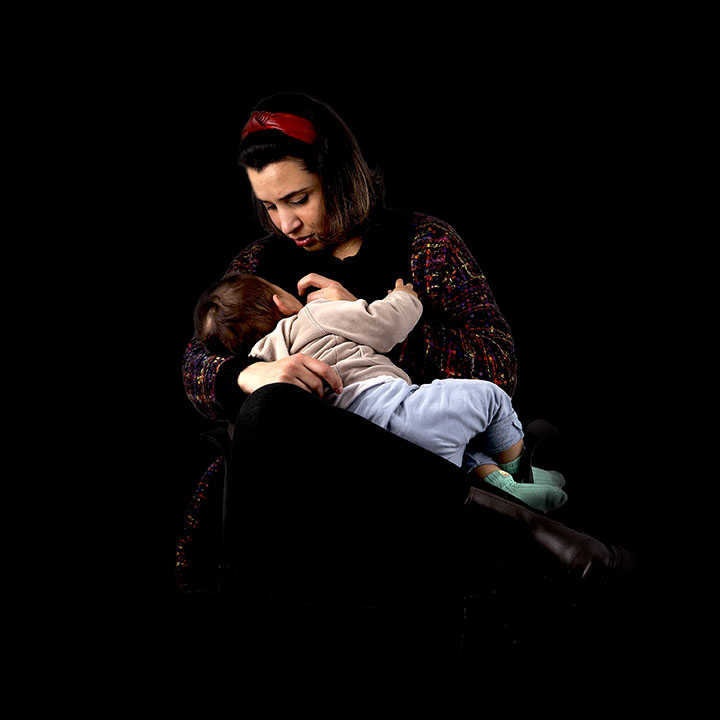
Interview with Rana
[00:00:00] Rana: So, I was breastfeeding her and I was planning to breastfeed her for two years and I knew I was pregnant again when she just turned one. So this was for me, to me, about taking the decision whether to stop breastfeeding or to continue. And I felt very stressed, um, because the second pregnancy, when it comes, there’s a lot of guilt towards the first, especially being so young.
[00:00:26] Rana: And I felt even more guilty around, so I thought I’ll just, I’ll continue receiving her, and then I’ll try and improve them both. She won’t be even two yet, so I’ll, I’ll continue with my plan. What happened is, my pregnancy was quite high risk. I had complete placenta previa and suspected placenta equilita, which is a rare condition, and I was prone to bleeding or early labour.
[00:00:53] Rana: So, the advice was to stop anything that would put me into early labour, so I stopped breastfeeding her when I was around five months pregnant. I did very gradually. What took time was the breastfeeding her to sleep at night, And I tried doing it for weeks and weeks, one day, she just slept without me breastfeeding her.
[00:01:20] Rana: And somehow, like, mourning the idea that I’m no longer breastfeeding her. But I kept saying to myself, when I have the baby, I’ll offer her to breastfeed. And I’ll, she’ll probably, she will definitely, I think she will definitely take, take it back again. Like, this will be only I have a baby in three, four months from now.
[00:01:40] Rana: I have an early left to see section. And she completely forgot about breastfeeding. When I offered her again, she’s like, how’s that? She grew out of it and that was it. Somehow, because for me, she’s not a baby anymore,
[00:02:04] Lisa: so Is that one of the subjects that you’ve been writing about in the workshop? Yes, yes. I mean, it’s, it’s so interesting because so many people feed a baby for a year, think that is fantastic, and have no Regrets, but it’s really interesting that sort of guilt that often comes in that you can’t explain it.
[00:02:25] Lisa: It’s not rational, is it? It’s coming from inside and it’s to do with that loss of a relationship, I suppose. Do you think the, the relationship between the two of you, the fact that now you have this other child that you have to split your attention with, and all of that. It’s complex, isn’t it? Like loving two children when before you only had one child to love and finding time for both of them and giving them both what you think they need.
[00:02:53] Lisa: Yes. I, I think it’s
[00:02:56] Rana: because also her breath was traumatic, right? I was completely convinced I would have a natural water birth, no medication, no epidural. I’ll just, I’ll wait for the signs to come. No, no induction, no sleep, nothing like that. So, and, and I waited for my due date and then after my due date passed, 41 weeks.
[00:03:20] Rana: 42 weeks, and there was no signs of labour, so I said, oh, okay, I’ll, I’ll try the induction. And for two days, uh, the induction didn’t work, so I ended up having C section.
[00:03:36] Lisa: Oh, I’m so sorry. Was it painful for two days, or was it just sort of hanging around, waiting for things to happen?
[00:03:43] Rana: It was all right. I was in a hospital.
[00:03:46] Rana: And it was, I think, more emotionally draining, not knowing what’s happening, because I’m a doctor myself and I know that adoption has, like, there’s a few signs meaning, like, how far the baby is engaged, how far the cervix is dilated. And I did not have any of these signs. So I had a feeling that probably it won’t work.
[00:04:10] Rana: And I asked them, is it, is it going to work? And they said, yes, yes. Sometimes it just needs like a little bit more push. Then I took the decision to have the C section. And not to wait for
[00:04:21] Lisa: longer. Yeah, that was probably a very good move, I would say. Yeah. I mean, I’m not a doctor, but I’ve interviewed so many women who have carried on, and it’s gone on for days and days, and by the time the baby’s born, you’re so exhausted that you’re in, you’re in an altered state.
[00:04:41] Lisa: You’ve been going through something that’s taken so long, you know.
[00:04:45] Rana: And I was more scared of, basically, Yeah. Like needing an emergency C section where the baby is stuck and then we run to, so I didn’t want that, I didn’t want any instrumental delivery, so I felt it’s time to decide about a C section and I, it was a Sunday weekend and I already had, it wasn’t the best experience of course, meaning that I’m going in the hospital bag, With like a swimming dress and lavender oil and things like this, I’ve been prepared for a C section.
[00:05:20] Rana: And then, she needed support, so she, I think, the induction caused it. A little distressed, she needed some oxygen support when she was out, so I did not breastfeed her right away. So I had this guilt, like lingering, always, that I didn’t breastfeed her, and it went out of my hands. Was she in the NICU? So yes, she was in the NICU.
[00:05:47] Rana: How long for? Just for the night. So I was struggling to convince the doctor’s nurses over there to try and breastfeed her while she was in the NHS, just a couple of hours after the delivery. So while I was in the, still in the, like, operation theatre, and they were asking me, Do you want us to give her, um, fluids or formula?
[00:06:08] Rana: And I said, I don’t know, I don’t want formula, so fluids, and then being out, I just learned that fluids is basically IV fluids. Yeah. So, it was a decision that I needed to take while still at the operating theatre, and I felt like everyone talks about the perfect scenario, like the golden hours, skin to skin, and all this, and no one talks about when things don’t work.
[00:06:36] Rana: It goes in a not very straightforward, and needs, and what happens, and how should people like, that makes the fate, it made me feel a little bit incomplete experience, or if I couldn’t give her what she needs at the moment. So when I, so I thought I’ll just breastfeed her for two years, and then I had to stop breastfeeding midway, and this was a little bit.
[00:07:08] Rana: Can
[00:07:10] Lisa: I go back to when she was in the NICU overnight? You were, obviously, you came out of surgery and were in bed. Did you get to see her? Before
[00:07:21] Rana: the anaesthesia, I told him to push my bed to the NICU, and I went there, and I was trying to convince the nurse to lightly breastfeed her, or even try to hold her and have her skin to skin.
[00:07:36] Rana: That was a couple of hours after the C section. So, eventually, a nurse or a midwife said, yes, we could do that, we could do nasal oxygen, and then we could bring her out to you. Um, and you can try and rest your nerve. And, but like, no one told me about Colostrum harvesting. Except when I passed. No one told me about what to expect after C section.
[00:08:03] Rana: I learned about this in medical school. It’s called Transient Ticketing of Newborns. It’s quite common for C section ladies. It’s something common.
[00:08:10] Lisa: It’s called what, sorry? I didn’t catch that.
[00:08:13] Rana: TTP. TTP? Transient Ticketing of Newborns. So it’s basically that a baby is born by a key section, they don’t get their fluids.
[00:08:22] Rana: expelled like the normal delivery. So they need some oxygen support at the beginning. I see.
[00:08:29] Lisa: Does that mean that they all need that extra oxygen? All of them? Or is it just sometimes they need that? Not all of them, of course. So my son
[00:08:38] Rana: was born early. It was expected that he will probably need NECU. He didn’t.
[00:08:44] Rana: He was fine. So it’s not uncommon. So when they take the consent of C section, They talk about all the complications, no need to the mother, and they talk about I did lose some blood, but I did not need any transfusion with my first. I did need blood transfusion with my second. But they don’t talk about the baby, that they might need some support, and they don’t talk about how Mothers who are keen on breastfeeding, who do things like colostrum harvesting.
[00:09:22] Lisa: Yeah, yeah.
[00:09:23] Rana: The colostrum harvest is lying around at the hospital.
[00:09:26] Lisa: Yeah.
[00:09:27] Rana: But I, I never thought I would need it.
[00:09:30] Lisa: You could have done that when you were being induced for those two days. Exactly, yeah, but no one told me about that. Was that at Bradford Infirmary? Yes, yeah, this was my first baby. That’s interesting feedback for Bradford Infirmary.
[00:09:45] Rana: I had my second baby at St James and Leeds because of my, um, of my complicated pregnancy.
[00:09:52] Lisa: Yeah, yeah. But I
[00:09:53] Rana: mean, I think Bradford, they have a great infant feeding team. They’re a good community. They do,
[00:09:59] Lisa: yeah. There
[00:09:59] Rana: is, but I think it’s linking people to those teams. This is where the problem is, like there’s, I know that there, so this is what I meant in my second pregnancy, so I self referred to every possible service, and it did, it was helpful.
[00:10:18] Lisa: How did you do that? How did you do that research?
[00:10:21] Rana: So, my second baby, I had him at 35 to 36 days, so 35 weeks to space, so it’s considered premature. So I was expecting that he would probably need support. I was really keen on breastfeeding her, so I started googling, like, on the breastfeeders. First, I contacted the breastfeeders, and although they don’t support, you know, active in my area in Shipley, they were still helpful.
[00:10:51] Rana: They visited me, they spoke to me about how to advocate for myself, and then I self referred also. To the Community Incentive Team.
[00:11:04] Lisa: Yeah.
[00:11:04] Rana: And they were super helpful. So, my little boy, he had a home time.
[00:11:11] Lisa: Yeah.
[00:11:12] Rana: And for some reason, it could not be stopped by any of the midwives or health visitors. They said as long as he’s gaining weight, it is not of concern, it’s fine.
[00:11:23] Rana: But was it painful? It wasn’t too painful for some reason, he managed to adapt and latch.
[00:11:29] Lisa: Okay.
[00:11:30] Rana: When I went to the community infant feeding team, I told them about my concern, and they referred me for the assessment, um, Tung Thai Clinic. And when I went there, the midwife, who is the Tung Thai expert, said it’s too tight.
[00:11:45] Rana: She doesn’t know how he does that. He doesn’t, she, she didn’t know how he, is he latching and gaining weight while he, he, he had a very tight hold time. Wow. He needed to be done twice. So it needed to be snapped twice. So it was really, really tight. And she said, yeah, that would have not only affected His latch, but also the shape of his palate.
[00:12:13] Rana: This would have affected his speech. His speech, yeah. Even somehow his breathing. Wow. It was causing a lot of colic because he was swallowing a lot of air.
[00:12:28] Lisa: Wow. So really it was very good that you caught that.
[00:12:32] Rana: Yeah, and it was, I mean, I tried to Several health pictures in community midwives. were coming and visiting, but they were not concerned because they said as long as you’re gaining weight, we cannot refer you.
[00:12:47] Rana: Yeah. The only reason we would refer you for Tong Thai Clinic is if you’re not gaining weight.
[00:12:54] Lisa: Oh, that’s interesting. It’s kind of a bit of a technical point though, isn’t it, really? I mean It
[00:12:57] Rana: is. And when I talked about that to the Tong Thai experts like the Tong Thai midwife, she said you need to file a complaint because The numbers that a few people who reach the Tung Tsai clinic and get it done there, sometimes it’s not enough for commissioning to keep it going.
[00:13:19] Rana: Oh, really? Or to help, or to keep it, or actually to keep, like, it will still be going, but they need, like, more staff. More trained staff, but they, since the numbers are not that
[00:13:30] Lisa: high, somehow. It’s really good that you went and also that you got that caught. Yeah. So, between the two of them, you’ve, you’ve had quite a lot of, um, stuff to deal with, haven’t you?
[00:13:41] Lisa: Between the two different births and the two different breastfeeding experiences. Are you comfortable breastfeeding in public in Bradford? Do you take your babies out? Yeah?
[00:13:52] Rana: Yeah, yeah, we go out almost every day. That’s nice. So I think it’s quite good in terms of activities for toddlers and it’s not going on.
[00:14:00] Rana: Oh
[00:14:00] Lisa: yeah. Where would you go with the two of them? Because obviously having two, you’ve got kind of like specific requirements, haven’t you, in terms of where to go. Where is a good place to go with two young babies?
[00:14:12] Rana: So there is the activity den, it’s an Yiddish community centre in Sheffield Town Centre and they have lots of activities going on, so we do Zumba.
[00:14:24] Rana: We do mommy and me like this. Nice, that sounds good. I mean, do they have soft play there as well? No, it’s just an open space that is being used for different activities. Is it like a family hub? Sort of, yeah,
[00:14:39] Lisa: yeah. Yeah, yeah. I’m hoping some of the portraits will go in the family hub network. Certainly, that’s sort of more and more who I’m working with because Yeah, that’s where parents go, isn’t it?
[00:14:49] Lisa: You’re only in the labour ward maybe for a day, but actually might go to a family hub every week for months on end. So even for, let’s say, parents who might not have managed to breastfeed their first child, when they have their second child, they might have, they might have learned more about it. So it’s kind of health education and breastfeeding promotion sort of thing.
[00:15:12] Rana: It’s a nice painting in the maternity
[00:15:16] Lisa: Yes, I know, it’s gorgeous. Yeah, I took a picture of the infant feeding lead in front of that. It’s really beautiful, isn’t it?
[00:15:24] Rana: Yeah, and it was touching for me because when I was pregnant I was going there and I felt like, Oh, I could do that because she’s breastfeeding two babies.
[00:15:32] Rana: Yeah. And all day. So I thought, oh, I could do that. So it was, yeah, I really liked it. Oh,
[00:15:42] Lisa: it’s amazing what is possible. But, you know, the thing is, in your circumstance, that just wasn’t to be. And like you say, the birth, the breastfeeding, it doesn’t all work out how you always want it to. So it’s a question of trying to feel good about how well you’ve done, because you’ve done a great job.
[00:15:59] Rana: So, my second pregnancy was a lot more complicated, but I was open to all the possibilities, so I did this eye, colostrum harvesting, while waiting for the consultants, while being prepared for the C section.
[00:16:19] Lisa: Yeah, that’s great, so you were really primed and ready.
[00:16:22] Rana: Yeah, I had a few syringes ready for him, and we had skin to skin, although my surgery was quite short.
[00:16:30] Rana: A little bit intense, but yes, he’s just came and I managed to breastfeed him right out of the
[00:16:39] Lisa: operating theatre, operating room. Oh, so that was a much more satisfactory start to his days in the world. I wanted to go back to the NICU, the separation from your baby.
[00:16:53] Rana: Yeah.
[00:16:54] Lisa: It’s nice you found that midwife who helped you to do that breastfeeding, actually in the NICU, that’s kind of amazing that they were able to facilitate that.
[00:17:05] Lisa: Then did you go back to your, to the labour ward in your bed? Were you wheeled back?
[00:17:10] Rana: Yes, so I was wheeled back and in the BRI, there is It’s quite far away. Yeah. It’s quite a distance. The NICU. Because the NICU, yeah, the postnatal ward is on like the fourth floor up. So, I was keen on breastfeeding. Once I started breastfeeding, I said, I want to continue doing this.
[00:17:31] Rana: So, they said, but she will need to come every two hours or when the baby cries. So, I said, I gave them my number and I happen to call me every time she cries. And that’s what I did. They rang me. How did you get there though? I asked a nurse to push me. In a chair? In a wheelchair, yeah.
[00:17:56] Lisa: I told them if
[00:17:57] Rana: So they gave her one formula, but Whenever she cried, I, I went there to feed her.
[00:18:04] Lisa: Yeah, how amazing. That’s, that’s incredible. And it’s really amazing to hear they supported you in that way on the labour ward, that, that there was someone to take you every couple of hours. And were you in hospital for long?
[00:18:20] Rana: With my first only for three days. So,
[00:18:26] Lisa: was that every two hours, day and night, that you were going up to the NICU?
[00:18:30] Lisa: Yeah, so she was with
[00:18:32] Rana: me,
[00:18:32] Lisa: I asked them,
[00:18:33] Rana: so she was off the next day, so I basically went once the sun was up, I just stayed in the NICU until they discharged her to my room. Ah. So they felt like, OK, she’s fine, she doesn’t need oxygen or anything, she’s stable, so bye. Bye. Midday, they discharge her to my room, because I had it, I had it like a side room, so.
[00:18:57] Rana: In St James, they have like a ward called Transitional Care, where they could have, they care for both baby and mother at the same time, even if they both need extra support. So there is, there is an EQ, but if babies are not like very unwell, They would stay with the mothers in the transitional care, which I feel, it was really good.
[00:19:21] Lisa: That sounds amazing. Yeah, so it’s kind of like an in between where it’s a bit more extra support.
[00:19:28] Rana: Yeah, and the NICU is on the same floor as the post in St James. So, even if they need the baby to be in their NICU, it’s not
[00:19:38] Lisa: too far away. Oh, I see. Yeah. So, the mothers are really just very close to the NICU in Leeds?
[00:19:45] Lisa: Yes. Hmm. I suggest an area I’m really interested in because I’d like to develop a VR version of the Holding Time animations for mothers whose babies are in the NICU for a duration. You know, mothers who are separated and where the baby can’t be lifted out of the unit. and the mother’s trying to express because I think that’s a really very difficult task that a lot of mothers have to do and, um, it’s, it’s, it obviously does massively.
[00:20:24] Lisa: impact the long term outcomes of each child if, but it’s a huge pressure on a mother who maybe has had a possibly a traumatic birth or a sudden unexpected c section, even a planned c section. I think it’s still Just so much to go through to give birth and then be separated from your baby and then have to express milk.
[00:20:49] Lisa: I think it’s a lot. And I’m just trying to think of ways to help in that instance.
[00:20:55] Rana: Yeah.
[00:20:56] Lisa: You know, using this project.
[00:20:57] Rana: In Bradford, that location of Nikki being so far away from the po Yeah. Even, even if, I mean, in my case, my baby wasn’t too unwell, just needed some support. And like, was under observation, that was the main thing.
[00:21:13] Rana: reason she was in the NICU. The first 24 hours, which is the most important, if I couldn’t go and rescue her, she would not have the chance, just because being too, too far away from where the mothers are.
[00:21:29] Lisa: Yeah. Yeah. So they probably have responded to that in the Leeds hospital. It might be a newer hospital where they’ve
[00:21:37] Rana: I think St
[00:21:37] Lisa: James is quite old.
[00:21:39] Rana: It’s a very old hospital. Is it?
[00:21:40] Lisa: Oh,
[00:21:41] Rana: interesting. It is, yes, I mean And even the, I know the maternity unit in Bradford is
[00:21:49] Lisa: newish, they have It is pretty new actually, thinking about it, the whole hospital is very new. Yeah, it’s a very modern place, isn’t it? So in that case, the architects that built that just didn’t, or whoever put that project together didn’t think much about this particular need.
[00:22:08] Lisa: It’s interesting, isn’t it, that you would have a maternity unit and a NICU so far apart, but I see that all the time in hospitals. It’s really common. To have it far apart. Yeah, it’s really, it’s really, really common, surprisingly so. And you think, how are the mothers supposed to get to their babies, you know?
[00:22:27] Rana: Yeah, it was very painful because our first night with our nursing section is very, very painful. So, trying to Get out, get on a wheelchair and move all the way. And then outta the wheelchair too. Wheelchair, someone would bring the baby and trying to position for a good latch.
[00:22:51] Lisa: Yeah. All of that’s very tricky, isn’t it, in a hospital bed.
[00:22:54] Lisa: Yeah. As well. Which is not a wide bed. Yeah, yeah,
[00:22:58] Rana: exactly. Yes. So I know, I mean, when I go to the nicu, I would just be sat on a chair, not the bed. The bed, just for the first. Time when I’m, but otherwise I’m on a wheelchair, which is even trickier, trying to position the baby and feed, feed her on a wheelchair.
[00:23:18] Rana: It’s just really
[00:23:19] Lisa: difficult. Yeah, that is just so, so hard with a newborn. But you, you got there Rana and you did a great job and you’ve got the two of them, they both look really healthy and well. It’s great that you’re processing that experience now through the workshops though, and I hope that also being photographed will be part of your journey of, you know, making sense of all of it, because it’s a big, it’s a lot of experience in a short amount of time, isn’t it?
[00:23:53] Lisa: It is, yeah, absolutely. I’m really grateful to you for sharing that experience with me today.
[00:24:00] Rana: Lovely talking to you, Lisa. Bye bye. Thank you. Bye.
[00:24:02] Bye. Bye.