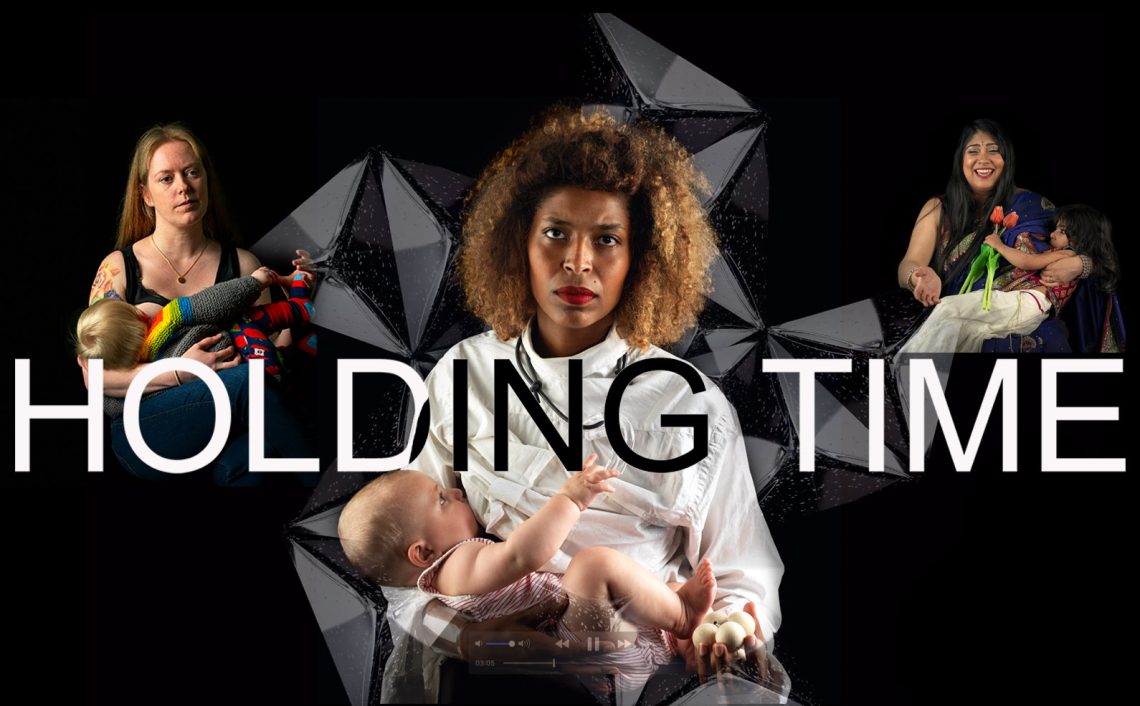

This has been one of the most powerful projects in Halton around breastfeeding and perinatal mental health. Using creative arts to explore, reflect, connect and share mother’s stories has been a revelation.
In Halton, the Holding Time project became part of a wider local effort to support mothers, strengthen breastfeeding culture and create more welcoming spaces for families. Through poetry, portrait photography and community events, the project invited mothers to reflect on their experiences of feeding and bonding — and to share those stories publicly.

Beginning with conversation
Holding Time arrived in Halton as part of a broader programme led by Halton Borough Council and Halton Family Hubs to improve breastfeeding support and shift public attitudes over time. In communities where breastfeeding has not always felt like the local norm, the aim was to create new ways of talking about early motherhood — ways that felt personal, creative and supportive rather than clinical.
The project began with the launch of the Holding Time audio trail and a photography exhibition at the Halton Breastfeeding Celebration Event at Norton Priory in Runcorn in 2024. Alongside this, poet and facilitator Rachel New led a series of creative writing workshops with mothers through Halton Family Hubs.
These sessions offered something rare: time and space for mothers to reflect on the early weeks of parenting, the emotional complexity of feeding a baby, and the changes that come with becoming a parent.
For many participants, it was the first time their experiences had been listened to in this way.
Between Us: portraits and poetry
The workshops evolved into a new project titled Between Us. Mothers developed poems exploring feeding, bonding, identity and the physical closeness of early parenting. At the same time, photographer Becca Smith of Little Wonderland Photography created a series of portraits capturing quiet moments between parents and their babies.
Together, the poems and photographs formed an exhibition that celebrated the relationship between parent and child — not through idealised images, but through honest reflections on what those early months really feel like.
The exhibition premiered at the 2025 Halton Breastfeeding Celebration Event at The Glass House in Victoria Park, Widnes. More than 300 people attended, bringing together families, health professionals, community organisations and local residents. Following the launch, the work toured venues across the borough during the summer, alongside a printed anthology and online gallery.
Creativity as support
The project also became part of a growing conversation about the role of creativity in maternal wellbeing.
Researchers from Liverpool John Moores University evaluated the workshops and found strong evidence that the programme supported participants’ wellbeing. Mothers reported increased confidence, stronger social connections and a sense of meaning and accomplishment through sharing their stories.
Many participants described the workshops as different from more traditional forms of support. Writing and reflection allowed them to process experiences in their own words, while the group setting created a sense of community with other parents navigating similar moments.
A shift in culture
Halton recorded increases in breastfeeding initiation and continuation rates. Between 2021/22 and 2024/25, breastfeeding initiation rose by 5.6% to 55.1%, while continuation at six to eight weeks increased by 9.7%.
The case study does not attribute these changes to a single project. Instead, it highlights the importance of a wider local strategy combining health services, community initiatives and cultural programmes such as Holding Time.
Together, these efforts help reshape how breastfeeding and early parenting are seen and supported within a community.

A legacy that continues
One of the most important outcomes of the Halton project is that the work has continued beyond the exhibition itself.
Rachel New worked with Halton Family Hubs to develop a training programme so that the creative writing workshops could be delivered by local practitioners. Twelve staff members across services — including the Infant Feeding Team, Perinatal Mental Health teams, Dad Matters, Parents in Mind and community volunteers — were trained to facilitate the sessions.
These practitioners now meet regularly to share learning and continue developing new groups for parents across the borough.
In this way, the project has moved from a one-off cultural event to an ongoing creative health resource embedded within local services.

Holding Time in Halton
At its heart, the Halton project shows how creative work can open up new ways of supporting mothers.
Through poetry, portraits and shared storytelling, mothers’ experiences are given space and visibility. Conversations that are often private become collective. And the everyday work of feeding and caring for a baby — so often unseen — becomes recognised as something powerful.
Holding Time in Halton is not just an exhibition or a set of workshops. It is part of a longer process of cultural change: making motherhood more visible, more supported and more connected within the life of a community.